I have and a friend who some years ago spent a year and a half and a day in Saudi Arabia. The time is important because it made his income tax free. For the first few years I knew him (and perhaps to this day) he made his living essentially by changing that money back and forth into other currencies (generally the Swiss Franc) picking up a little gain on the changes in the relative values of the two currencies. Apparently he did it pretty well, because he rarely sought employment and lived relatively well.
Currency carry trade is a lot like that but on steroids, and involves the arbitrage on the interest differences as well as the relative value. One borrows money somewhere where the interest is arbitrarily low (like the US right now) and parks the money in bonds somewhere else with a higher return. In some cases, like George Soros, where your wealth and credit support it you even short the money - you invest money you don't even have yet!
Aside from the magnitude of the process (read too big to fail), there are examples with common sense failures in our ordinary experiences with this. I have two examples from the period of time I was in college many years ago. It was a time before computers when the velocity of money was not the speed-of-light, and we mere mortals could play too. It was just as illegal then, but time worked for us not against us. And we were too little not to fail.
In the first mea culpa, I lived in Pennsylvania, and went to college in Illinois. I had bank accounts in both states. When I didn't have enough money in Illinois, I drew upon my account in Pennsylvania and deposited it in my bank in Illinois. Ultimately, my money in Pennsylvania from my Summer job and allowances were running down, I did what the big boys do now ... I wrote a check on the Illinois bank and mailed to Pennsylvania. And then I could deposit a Pennsylvania check into my Illinois bank to cover it. I managed to do this for quite a while. Eventually It all fell apart. I was lucky, the small town bank in Illinois let me have a loan and I paid it off by working a small job in a woodworking factory before they caught on. But it didn't have to turn out well ... I quit while I was still ahead. Beats prison.
My other mea culpa is a he-a culpa. My college classmate Alan had a small business going buying old cars at auto auctions with a bad check. Tow-barring them home two at a time, cleaning them up and taking them to another auto auction where he would sell them at a profit, cover his check and pull a little out for himself. This one did not come to a good end though. One snowy night while coming home, he skidded on ice and wrapped his investment around a tree. Alan had to go hat-in-hand to his father who ran a savings-and-loan in a nearby small town to bail him out.
Right now, there are many 'Alans' and many 'me's. It is said they are too big to fail. I think the full statement has been truncated. They are too big to fail without taking the current currency system down with them, just as Alan and I took our wealth down with us. Morgan Stanley, and George Soros have the United States Government as their daddies to bail them out, but who it the United States Government's Daddy? I guess it will need to get a part-time job.
As my daughter would say "No good can come from this."
Showing posts with label currency. Show all posts
Showing posts with label currency. Show all posts
Tuesday, November 17, 2009


Wednesday, June 17, 2009
Debasing Our Currency
From the The Coinage Act of April 2, 1792
(1 Stat. 246)
It sounds like our founding fathers were a little serious about their money. I wonder what they would think of the current lot of rounders who occupy Washington, DC, today, who are not content to debase the currency 100%, but are now debasing even that? Out predecessors were so serious about unbacked money that even Lincoln's piddling little foray into United States Notes reverberated anger for fifty years. And that was a parallel currency to provide liquidity in times of hoarding.
The United States Constitution itself is also rather serious about its money. From Article One, section 10 reads:
(1 Stat. 246)
Section 19. And be it further enacted, That if any of the gold or silver coins which shall be struck or coined at the said mint shall be debased or made worse as to the proportion of the fine gold or fine silver therein contained, or shall be of less weight or value than the same out to be pursuant to the directions of this act, through the default or with the connivance of any of the officers or persons who shall be employed at the said mint, for the purpose of profit or gain, or otherwise with a fraudulent intent, and if any of the said officers or persons shall embezzle any of the metals which shall at any time be committed to their charge for the purpose of being coined, or any of the coins which shall be struck or coined at the said mint, every such officer or person who shall commit any or either of the said offenses, shall be deemed guilty of felony, and shall suffer death.
It sounds like our founding fathers were a little serious about their money. I wonder what they would think of the current lot of rounders who occupy Washington, DC, today, who are not content to debase the currency 100%, but are now debasing even that? Out predecessors were so serious about unbacked money that even Lincoln's piddling little foray into United States Notes reverberated anger for fifty years. And that was a parallel currency to provide liquidity in times of hoarding.
The United States Constitution itself is also rather serious about its money. From Article One, section 10 reads:
Section 10. No state shall enter into any treaty, alliance, or confederation; grant letters of marque and reprisal; coin money; emit bills of credit; make anything but gold and silver coin a tender in payment of debts; pass any bill of attainder, ex post facto law, or law impairing the obligation of contracts, or grant any title of nobility.It sounds like a restriction only on the states, but it is a restriction on itself as well, for in those days we truly were the United States of America, and not the People's Republic of America as we morphed into from the early 20th Century under the Progressives culminating in President Obama. And the Federal Government restricted by the Constitution and the Ninth and Tenth Amendments could do nothing that the states could not legally do unless written into the Constitution.
Thursday, September 25, 2008
Fractional Reserve
Our old money was honest. It said what it was, and what it meant. Gold and Silver certificates were like a receipt for a certain amount of "money" on deposit. Even the Government knew which of the look-alike bills seen in As Constant As the Dollar were which.

This one was from our "National Currency", our first Federal Reserve Notes. The banks would honor them for most purposes -- buying a loaf of bread, paying a salary, ordinary trade. What they were not good for was paying taxes or debts to the Government. In that case, only real money "lawful money" would do.
Both types of money circulated, but unlike the fiat currency of today, this fiat currency was kept at a strict ratio with the hard currencies of the time. It provided the liquidity necessary for commerce without diluting the value of the dollar.
Today's currency on the other hand is entirely fiat and is issued by the Governor and researchers of the Federal Reserve Bank based upon the perceived need for liquidity of the current economy. This is a tap-dance on a high-wire. Where anything can trip it up.
Now the currency is backed by our debt, by our willingness to pay in the future for the dollar of today. The baby-boomers are seeing retirement close in on them and are following the (correct) advice of Dave Ramsey and reducing their personal debt. With the intricacies of fractional currency, this reduces the debt backing and hence the dollars in circulation. This is compounded by the increase in loans to members of our society who do not have the ability nor intention to repay or ever carry their own weight. A crash not only was inevitable, it still is, for we aren't even there yet.
Issue an extra 800 billion and see what happens.

This one was from our "National Currency", our first Federal Reserve Notes. The banks would honor them for most purposes -- buying a loaf of bread, paying a salary, ordinary trade. What they were not good for was paying taxes or debts to the Government. In that case, only real money "lawful money" would do.
Both types of money circulated, but unlike the fiat currency of today, this fiat currency was kept at a strict ratio with the hard currencies of the time. It provided the liquidity necessary for commerce without diluting the value of the dollar.
Today's currency on the other hand is entirely fiat and is issued by the Governor and researchers of the Federal Reserve Bank based upon the perceived need for liquidity of the current economy. This is a tap-dance on a high-wire. Where anything can trip it up.
Now the currency is backed by our debt, by our willingness to pay in the future for the dollar of today. The baby-boomers are seeing retirement close in on them and are following the (correct) advice of Dave Ramsey and reducing their personal debt. With the intricacies of fractional currency, this reduces the debt backing and hence the dollars in circulation. This is compounded by the increase in loans to members of our society who do not have the ability nor intention to repay or ever carry their own weight. A crash not only was inevitable, it still is, for we aren't even there yet.
Issue an extra 800 billion and see what happens.
Sunday, August 24, 2008
As Constant As the Dollar
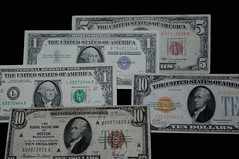
These are five of the six kinds of currency in circulation prior to FDR*. Although readily interchangeable for each other, each one really was different. Two of them were anchored in value, because they backed by a coin or block of metal of similar value. In truth, they were a receipt for ownership of that coin or hunk of metal. Therefore it was a "Certificate" of ownership. It was easier to carry and readily transfer the receipt than it was the metal itself. The other bills were promises. "We don't have it right now, it is tied up in other things - i.e. loans or property, but we can get you some metal. Hence it was a promissory note - a United States Note, or a Federal Reserve Note. The last is National Currency. This is a place-holder -- i.e. "We not only don't have it in metal right now, but we don't even have it on loan right now. We will get you some eventually". The purpose is to keep commerce moving. Since "A" will work for "B" and "B" will sell to "C" who will sell to "A" all we need is a barter ticket to keep track of the motion.It self-proclaims that it is exchangeable for "Lawful Money". Ipso Ergo, it is "Unlawful Money".
They were all interchangeable, as was the silver dollar that was really a measured amount of silver (until C. Douglas Dillon, President Lyndon B. Johnson's Secretary of the Treasury ceased redemption in March 1964). Gradually, these bills all have been removed from use, leaving only the Federal Reserve Note in circulation.
To quote the U.S. Department of the Treasury web site, "the [Federal Reserve] notes have no value for themselves, but for what they will buy. In another sense, because they are legal tender, Federal Reserve notes are "backed" by all the goods and services in the economy." Because that is neither a fixed amount nor relationship, the value is free-wheeling.
But do note that that full faith and credit never seem to work in the public's favor. That 10 cent Pepsi, now a dollar-thirty-nine
-- it wasn't the Pepsi that changed.
*The sixth was the National Bank note or "hometown note" issued by national banks (First National Bank of [Your-town here]) under authority of the Federal Reserve system.
They were all interchangeable, as was the silver dollar that was really a measured amount of silver (until C. Douglas Dillon, President Lyndon B. Johnson's Secretary of the Treasury ceased redemption in March 1964). Gradually, these bills all have been removed from use, leaving only the Federal Reserve Note in circulation.
To quote the U.S. Department of the Treasury web site, "the [Federal Reserve] notes have no value for themselves, but for what they will buy. In another sense, because they are legal tender, Federal Reserve notes are "backed" by all the goods and services in the economy." Because that is neither a fixed amount nor relationship, the value is free-wheeling.
But do note that that full faith and credit never seem to work in the public's favor. That 10 cent Pepsi, now a dollar-thirty-nine
-- it wasn't the Pepsi that changed.
*The sixth was the National Bank note or "hometown note" issued by national banks (First National Bank of [Your-town here]) under authority of the Federal Reserve system.
Subscribe to:
Posts (Atom)